
Excellence in English: My Progress in EGL Throughout My Dual Credit English Classes
How do you actually gauge your own progress in English? A semi-detailed analysis of my progression throughout dual credit classes.


Before we begin
I figured whoever is reading deserves an introduction. Hi! I’m Hayden, and I’m currently a dual-enrollment student at a high school and a local community college. I am withholding this information for privacy purposes, but this should confirm who is writing this blog post to the people who need to know. Other than that, I am a computer science major with a focus on cybersecurity, and I have taken English for all four years of high school, with the past year and a half being dual credit.
At the beginning of my first dual-credit English class, I had no idea what I was getting myself into. It seemed like the language I've always been speaking had been made unnecessarily complicated for the sake of creating another subject to learn in school. However, I feel like I'm well equipped to both analyze my progress and continue my learning of English, and I no longer am fazed or taken off guard by the assignments these classes throw at me. With all of that in mind, let’s jump in…
So, the big question...
How do you actually gauge your own progress in English?
It’s easy enough to ask a teacher or post online in a forum, but how often would you analyze your own writing?
Since I am nearing the end of my first semester of my senior year (and my third semester of college at this point), this task has now been assigned to me as my final “paper.” Of course, me being myself, I cannot take the easy route to anything. With this in mind, I created an actual blog post rather than writing a (boring) final paper. And you might have been able to tell the purpose by the (maybe) slightly unusual start for someone who is more known for technology than English. Anyways, with all of that in mind, this blog post will serve to give a semi-detailed analysis of my progression throughout the time I have spent in dual credit classes.
The statistics
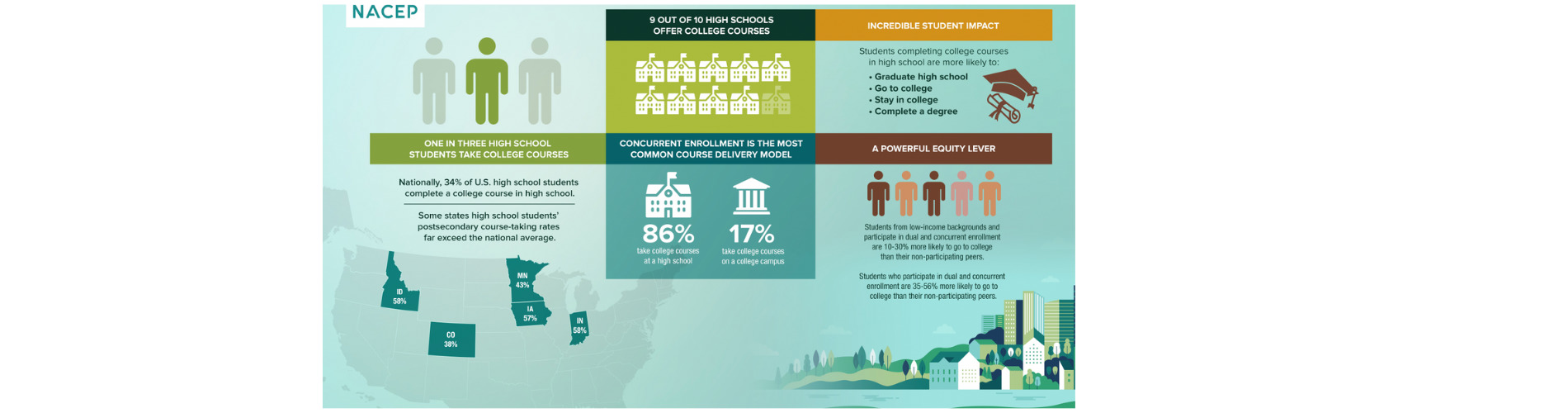
According to EdWeek, more than 40 percent of high school students that earned college credit in dual-credit classes went on to earn a degree within four years of graduating (Sparks, 2024). This statistic aligns well with the demand from high school students for dual credit classes as a way to get ahead. Dual credit provides this 40% statistic because it both allows students to get a taste of college classes early and allows those students to simultaneously gain college credits as they take that class. This takes a hassle out of the college process where a person has to take classes in high school just to take them again in college (cough cough, sociology). English and math are common contenders in the scene, and there are many classes to be taken (from junior year up, at least at my school as of writing this). Both parents and students have no reason not to love to ease of the school paying for classes that the student would likely have to take anyways if they are heading towards a two-year or four-year college or university. After all, what's not to love about that?
Further, a staggering 88% of dual enrollment students went on to college after high school and completed degrees quicker than their non-dual-credit peers (NACEP, 2023). This shows how big of an impact that dual-credit can have on a student's educational career. It also shows that there is a lot of motivation to be had in starting a dual enrollment class and already having that rhythm when they go off to college.
The long-awaited analysis
This is the part everyone (and particularly my teacher) have been waiting for. Drumroll please.
The analysis of my own writing.
To accurately analyze myself, I think that the best idea would be to take the first essay I ever wrote in dual credit English 101, and then put it against the essay I just wrote before this one in English 102.
Essay #1
Let's take my thesis from here.
This advertisement takes a unique approach by appealing to the audience’s emotions and attempting to present itself as credible, rather than risking using logic to draw these people into the casino.
This is a strong thesis. And that's not just me complimenting myself. The comment from my dual-credit then-teacher (I have no other idea how to word this unfortunately) pointed that out. I feel that I have always had a good feel for writing a strong hook and thesis, and those are a really good strong starting point for me. However, I then double back on my own statement and say that the voice speaking in the advertisement (see here) is a person who is "supposedly addicted to gambling." (Masters, 2024) My teacher points out this flaw and says that it's illogical to think the casino is trying to make the audience think the speaker is addicted to gambling. This makes sense, since that would take away from the whole point of the billboard. I tried to keep this in mind to avoid further contradictions of my own statements in future essays.
Further on in that specific essay, I use strong word choices a bit. These include "amiable" and "pertinent," which I'm particularly proud of using correctly (and that specific teacher was very specific about grammar) because it made me sound more professional as a sophomore (Masters, 2024). Other than that, most of the other comments are either about my use of pathos (as this was a rhetorical analysis) or grammar clarity. Honestly, a good portion of the problem could have been the fact that I was using Grammarly as a crutch for spelling checks. Given that it is powered by AI itself (and I know very well how reliable AI is since I've written enough papers on it), that could have been an issue in the past. However, another good step I've taken throughout my dual credit time is that I have stopped using Grammarly altogether. I uninstalled the extension, and I now manually check my own papers. But why? There's things that a basic spell check will catch that Grammarly somehow will not. Grammarly loves shoving their premium in your face. Most of all, a lot of the spell checks are flat out wrong. There's no changing that, and I've learned to avoid it, which has improved the grades I have gotten on my papers.
Essay #2
This next essay is my most recent EGL-102 paper. This paper is graded by a completely different teacher since my other teacher took a job at a different school for my senior year (along with every other change this year...). Anyways, here's that paper:
The first thing that jumps out on this one is the title. "Being Humane in an Artificial Domain." (Masters, 2025) I'm not sure exactly how proud I am of this title, but my English teacher seems to have liked it. I try to make clever titles, and while this one is clever, it's also just a little bit corny. Putting that aside, I did make a nice rhyming title, and that's an improvement from "Casino: Family or Foe?". This essay is also a rhetorical analysis but instead trends more on the side of a research essay. I used APA format throughout (as I've grown to prefer APA over MLA for a variety of reasons) and I have improved on consistency as far as citations go. I don't have a source to reference here, but I'm always afraid of my citations flipping between two different styles, so it's a relief to see that I've learned to maintain one specific (and easy) style to cite. There's always room to learn more, however, since I'm not sure APA is the go-to in the computer science field.
I also see improvement in the way I present my facts. I use a lot more statistics in my more recent papers, which proves indisputable proof towards (or against) a cause and strengthens my argument. I liked to provide a lot of personal opinions when I started writing papers, and it is extremely easy to do on topics I'm passionate about such as AI, but I've learned to present facts rather than opinions. This is especially important when I am writing research essays, as these have to be indisputable facts in research rather than someone going and saying "Oh, I think this because [...], and I am reputable because I say so." Nobody wants to hear opinions because they can form those on their own. An example of this in a quote from the first essay:
The ad does not use anything other than a singular quote from a singular person to try to prove its point. Sure, “Dorene M.” might be an unbiased person who relays this positive quote, but the likelihood of this is slim to none. If a survey for positivity in casinos were to be taken with random gamblers outside of a casino, it can be doubted that many would have the same opinions as Dorene has to say. Studies have been conducted and it has been shown to lower happiness. The ad's creators likely fabricated this quote for the advertisement only to draw the audience in with a seemingly real person saying a seemingly real quote. It uses both this quote and the human urge to want more and more of something to take them under the influence of casinos under the guise that this might be their chance for a big win. The literal odds are that they highly likely will not.(Masters, 2025)
With the use of words like "highly likely," "likelihood," "likely," and "might" show a lot of either uncertainty or flat-out opinions. It's pretty obvious to see what the objective is of the advertisement, and it's probably common knowledge that casinos aren't exactly the most warm, friendly, or happy places out there. That doesn't need to be restated. However, in my more recent essays I have been drawing less obvious conclusions and using statistics with concrete backgrounds. Instead of using my opinions, I use the indisputable facts. The following is a quote from my more recent rhetorical analysis:
She provided another example of how the ACLU utilized an AI model to analyze members of Congress from a database of over 20,000 photos. This AI created a nonexistent correlation between 5% of Congress members and criminals (Cataleta, 2020).(Masters, 2025)
In this snippet, I used specific numbers, a specific citation, and objective facts. There are no opinions here or anything that would derail the essay into a discussion of my own personal opinions instead of those objective facts.
In conclusion...
I think dual credit has done a lot for me. Writing papers is a skill that some people never get the opportunity to work on properly, and I'm grateful I have gotten the teachers that I have gotten for the past years. I genuinely don't think that I would have gotten this far without them. As far as my own progress, I do think I've made great strides in my academic paper-writing, and I know that my progress doesn't stop here. If I continue doing what I'm doing, if I continue utilizing my English skills and creating write-ups and posts on here about my tech doings and don'ts, if I don't forget everything I've learned in high school the second I've joined college... I think I'm definitely off to a great start.
Finally, I would wholeheartedly recommend dual credit not only as an opportunity to get ahead in high school/college but as a way to further career skills that you won't realize you need until you're glad you worked on them. This is a personal opinion, and is one of the few times you will see one of these in my research works. I would recommend you take it seriously, but check with your academic counselor if you are skeptical because they're probably more reputable than this blog is.
Thank you taking time out of your day to read this!
References

 Sarah D. Sparks